Research Spotlight: Can AI Help Solve the Recycling Bin Guessing Game?
Our first full week of the Tessa public preview has revealed a fascinating trend: the public is deeply concerned about how plastic waste impacts our world, with a massive surge of interest in research surrounding microplastics in our food supply.
To tackle the plastic crisis, governments worldwide are pushing hard to ramp up recycling and composting. But walk into any kitchen or cafeteria, and you’ll find the real bottleneck: human confusion. Most consumers can’t reliably tell the difference between non-recyclable, recyclable, and compostable plastics. When everything gets tossed into the same bin, recycling facilities are forced to resort to slow, incredibly expensive manual sorting.
The unfortunate result? Tons of perfectly salvageable material gets dumped straight into landfills anyway.
A study published last summer by researchers at University College London (UCL) aims to fix this exact issue. Titled “Using hyperspectral imaging and machine learning to identify food-contaminated compostable and recyclable plastics,” it explores an AI-driven method to sort the mess for us.
We ran this paper through Tessa to see how well its promises hold up.
The Tessa Verdict: A Verified Green Light
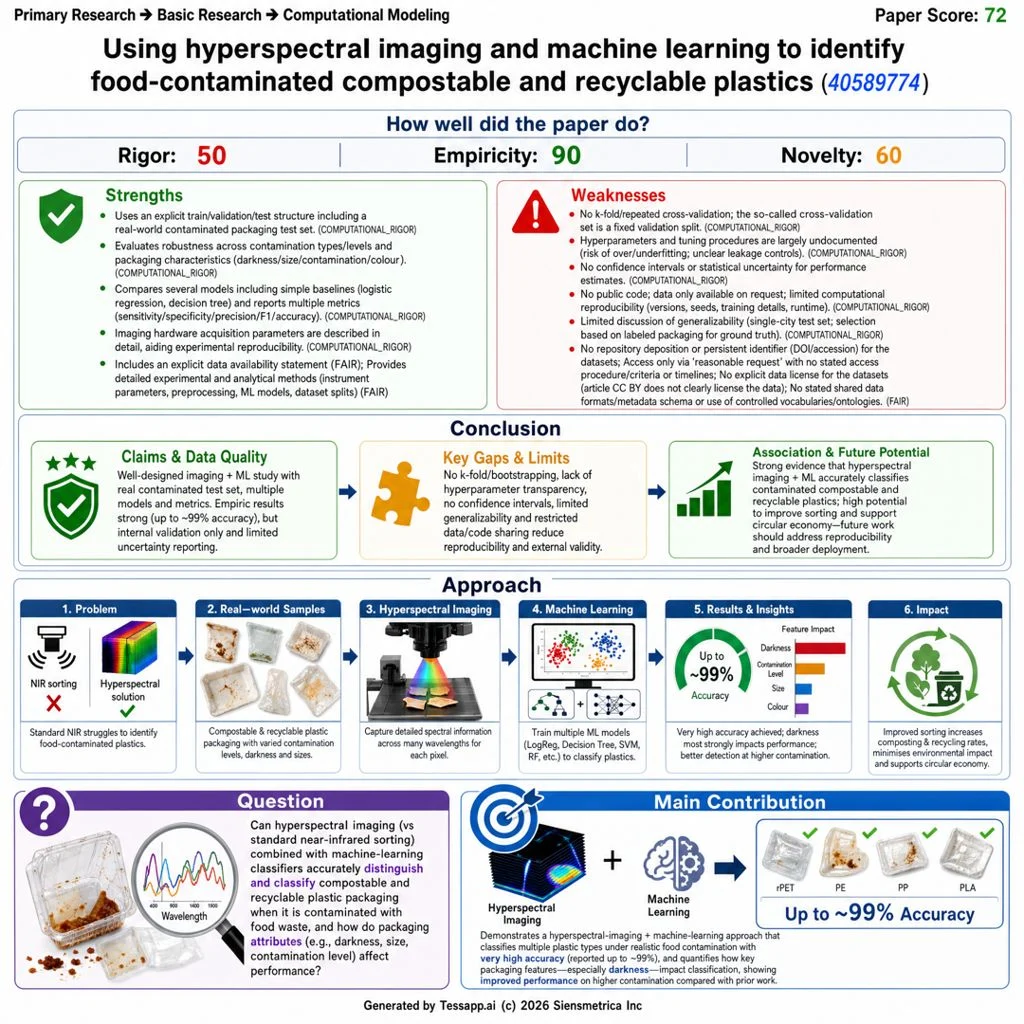
Overall T-Score: 72/100 (Green 🟢)
Tessa Insights: A score of 72 officially crosses the threshold into our Green zone. While it sits at the lower end of the green spectrum, remember that perfect science does not exist. A 72 actually places this UCL study in the top 20% for quality among papers evaluated, making it a highly credible and reliable piece of literature.
The Deep Dive Breakdown
- From Theory to Reality (Score: 90/100): This paper is highly experimental and hands-on. Instead of relying purely on clean computer models, the UCL team got their hands dirty by applying actual food contaminants (like ketchup and mayonnaise) to physical plastic samples. They even validated their system on a small batch of 30 real-world waste items. It only misses a perfect score because it hasn’t been tested in a live, high-speed commercial facility yet.
- Practical Innovation (Score: 60/100): Using advanced cameras and AI to identify materials is an established concept. However, applying it to the specific, messy problem of food-covered packaging adds a highly practical, timely upgrade to the field. It builds smartly on existing tech to solve a real-world headache.
- Scientific Rigor & Speed Bumps (Score: 50/100): This is the main reason the paper sits at a low green rather than a high one. While the researchers reported a success rate of over 90% (up to 99% in specific settings), their real-world test size was quite small (only 30 items). Additionally, the data analysis leaves room for overly optimistic accuracy estimates depending on whether the AI looked at individual pixels or the whole object. It also lacked standard statistical safety checks to prove absolute consistency.
Why It Matters
The UCL team has proven that advanced imaging can see past the ketchup stains to accurately identify what kind of plastic is underneath. Because it has earned a green score from Tessa, the foundational science is solid. While we still need to see it tested on a much larger scale before it hits local waste plants, this research provides a vital, high-quality blueprint for automated sorting.
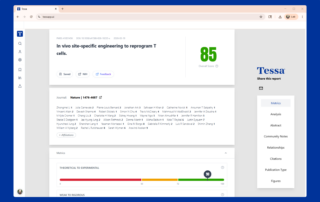
👉 Want to inspect the data yourself? Explore the full Tessa Report here.
Share This →
About the Author: Sage Osterfeld

Research Spotlight


Recent Posts