Beyond the Gut Health Hype: Mapping Microbiome Diversity to Frailty and Longevity
It seems like everyone is trying to “hack” the gut these days. From prebiotic sodas to endless probiotic supplements, “gut health” has exploded into a massive lifestyle trend. But beneath the marketing hype, real science is digging into how our microscopic long-term residents actually impact severe clinical outcomes.
A newly published study in Nature Communications sheds light on this by exploring the direct relationship between the gut microbiome and frailty in older women. Researchers tracked 2,081 older Swedish women over a median of 7.9 years to see how specific gut features correlate with physical decline, fractures, and overall longevity. To ensure their findings weren’t just a regional anomaly, they cross-referenced their results with an independent replication cohort of 1,448 older adults in China.
Noteworthy & Significant Findings
What makes this study particularly remarkable isn’t just its scale, but how it shifts our understanding of healthy aging:
- The Frailty Mortality Index (FMI): Instead of relying on standard, disease-centric models like the Charlson Comorbidity Index (CCI), the researchers developed a multidimensional FMI. This index integrates physical performance (like walking speed and chair stands) with psychological and lifestyle factors. The FMI proved significantly more accurate at predicting mortality risks than traditional methods.
- Severe Risks Quantified: Women classified in the severe frailty quartile faced a staggering fivefold higher risk of death, a twofold higher risk of hip fractures, and a significantly elevated risk of injurious falls compared to their non-frail peers.
- Microbiome Diversity Matters: Higher frailty directly mirrors a sharp decline in gut microbial diversity and overall gene richness. Conversely, high microbial diversity was strongly tied to a lower risk of death and fewer fall-related injuries.
- The Good vs. Bad Bugs: The study isolated specific bacterial culprits. Frailty was consistently associated with an expansion of opportunistic pathogens like Enterocloster species and Clostridium Q symbiosum. On the flip side, women who maintained high physical function and greater survival rates possessed higher abundances of potential butyrate producers and anti-inflammatory microbes, such as Faecalibacterium prausnitzii clades.
- Cross-Continental Validation: Remarkably, over half of the top frailty-associated microbial signatures identified in the Swedish women showed the exact same directional patterns in the Chinese cohort. This strongly suggests a universal, cross-continental microbial signature linked to aging and frailty.
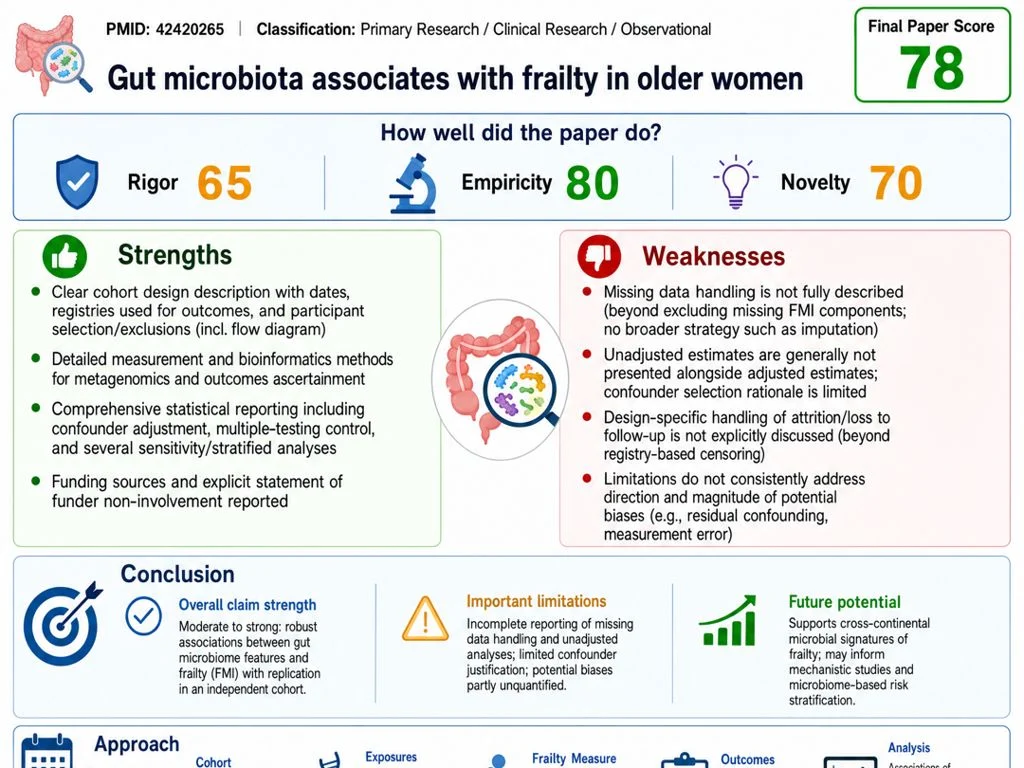
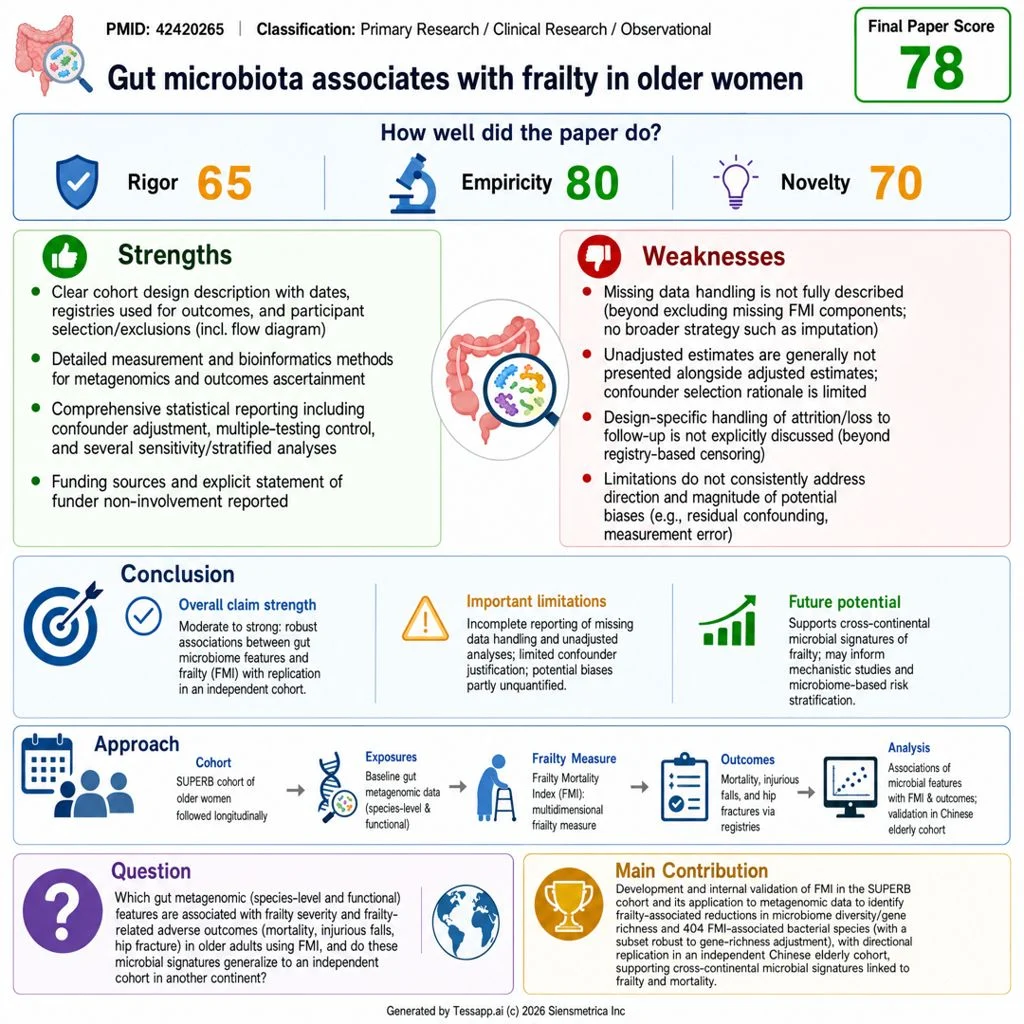
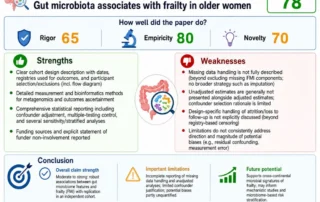
Tessa Overall Score
Tessa TScore: 78/100 (Solid Green) 🟢
An overall strong score indicating well-executed, high-quality research, though bounded by a few standard observational limitations.
Tessa Analysis Breakdown
Our AI-powered Tessa framework evaluated the study across its three core pillars: Transparency, Explainability, and Significance.
Sub-Scores
- Theoretical vs. Experimental: 80/100
- Weak to Rigorous: 65/100
- Known to Novel: 70/100
- Journal Score: 100/100
Protocol Assessments
To establish data integrity, Tessa cross-checked the paper against standard epidemiological evaluation frameworks:
| Evaluation Protocol | Focus Area | Result / Rating |
|---|---|---|
| STROBE v2007 | Reporting Completeness | 🟢 100% Complete — Exceptional structural reporting clarity across baseline tables, patient exclusions, and statistical models. |
| NOS Cohort Scale | Methodological Quality | 🟢 9/9 Stars — Excellent population-based sampling, secure laboratory exposure measurements, and long-term registry tracking |
| ROBINS-E v2022 | Risk of Bias | 🟠 High Risk — An inherent limitation of the study design. Because gut microbiomes and frailty scores were measured at the same baseline timepoint, it introduces potential for reverse causation and residual confounding. |
Analytical Strengths & Shortcomings
- Strength: The massive sample size spanning two distinct geographic cohorts adds immense statistical weight and replication confidence.
- Strength: Stringent multiple-testing controls (Bonferroni/FDR) and sensitivity adjustments ensure that the microbial links to frailty aren’t just a byproduct of baseline health declines or medication use.
- Weakness: Dietary data was not measured. Because diet heavily dictates gut composition, this leaves a notable window for residual confounding.
- Weakness: Single-timepoint stool sampling limits the ability to draw definitive causal arrows. We know the microbes and frailty are linked, but we cannot definitively prove which one causes the other over time.
Read the full, unedited analysis report here (includes links to the study): https://www.tessapp.ai/report/42420265
Share This →
About the Author: Sage Osterfeld

Research Spotlight

Recent Posts