Can a Common Joint Supplement Accelerate Alzheimer’s Progression?
A newly published study in Nature Metabolism has uncovered a surprising metabolic link in the development of Alzheimer’s disease (AD). The research, titled “Hyperglycosylation is a metabolic driver of Alzheimer’s disease,” suggests that an overproduction of specific sugar chains in the brain actively fuels the disease’s progression. Strikingly, both animal models and human health data indicate that glucosamine, the highly popular over-the-counter joint supplement, may inadvertently worsen outcomes for those already experiencing neurodegeneration.
We had Tessa analyze this paper to assess its structural transparency, experimental significance, and methodology. Here is a look at what the study discovered and how it holds up under close examination.
The Big Question: What is Hyperglycosylation?
In the human body, glycosylation is a normal, essential process where complex carbohydrates (glycans) attach to proteins to help them fold properly and communicate. However, the research team found that brains affected by Alzheimer’s display a massive accumulation of these sugar chains, a state called hyperglycosylation.
By using advanced imaging to map human post-mortem brain tissue, the scientists observed that this sugar accumulation increases steadily alongside disease severity (Braak stages). The core question of the study was whether this carbohydrate buildup is simply a side effect of the disease, or a direct cause of cognitive decline.
The Core Findings
To find the answer, the researchers turned to two distinct mouse models of Alzheimer’s and a massive database of human electronic health records (EHR):
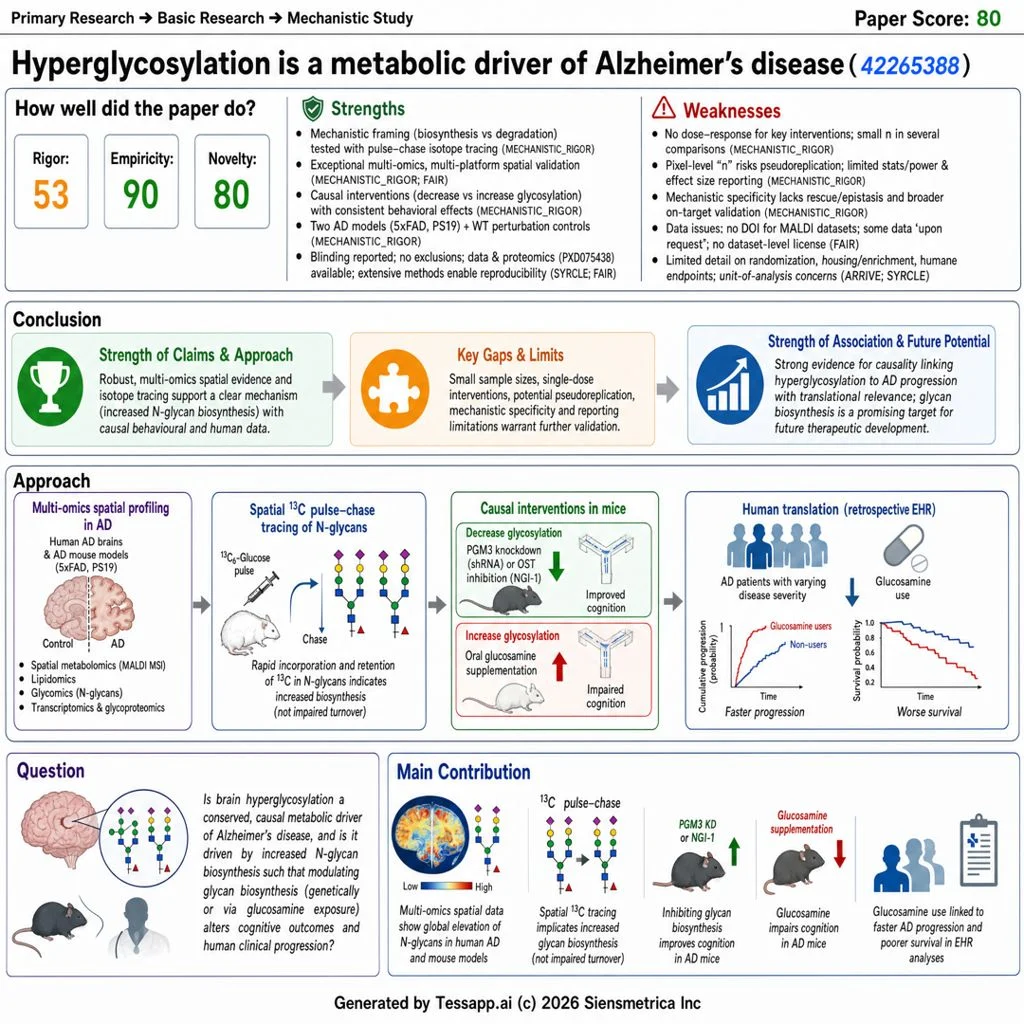
- Mapping the Mechanism: Using specialized isotopic tracing, the team confirmed that the sugar buildup is driven by hyperactive production of glycans in the brain, rather than a failure of the body to clear them away.
- The Glucosamine Link: Because glucosamine is a direct building block for these sugar chains, the researchers gave oral glucosamine supplements to mice with Alzheimer’s features. The supplement noticeably increased brain hyperglycosylation and significantly worsened their memory deficits. Conversely, blocking the sugar-producing enzymes restored cognitive performance in the mice.
- Real-World Human Data: Looking at records of over 50,000 patients from the University of Florida Health system, the researchers identified a sobering trend: patients diagnosed with dementia who took glucosamine for at least a year experienced accelerated disease progression and a 25% increase in mortality risk compared to non-users.
An Important Caveat: Interestingly, the negative effects of glucosamine appear contingent on an already vulnerable neurodegenerative state. Glucosamine supplementation did not cause sugar buildup or memory issues in healthy control mice, nor did it increase mortality in human patients with Mild Cognitive Impairment (MCI) who had not yet progressed to formal dementia.
Tessa’s Evaluation: Where the Paper Stands
Overall T-Score: 80/100 (Green 🟢)
Tessa assessed the paper with an overall Trustworthiness Score (TScore) of 80 out of 100, signaling highly robust science, though not without architectural limitations.
| Submetric | Score | Tessa’s Insight |
|---|---|---|
| Theoretical to Experimental | 90 | Highly data-driven. It pairs biochemistry and animal models with real-world human data, though the human portion is retrospective rather than a prospective trial. |
| Known to Novel Method | 80 | Strongly innovative. It connects an overlooked metabolic pathway to Alzheimer’s causality and successfully uses unique, cutting-edge spatial tracing technology. |
| Weak to Rigorous | 53 | While the biological mechanism is incredibly well-validated across multiple testing platforms, the score is mathematically balanced by a couple of design limitations. |
| Citation Analysis | HIGH | Exceptional integrity. 89% of the paper’s 54 citations are highly relevant and accurate, with no evidence of citation padding or reliance on retracted literature. |
Rigor Breakdown & Limitations
Tessa’s deep-dive submetric score of 53 reflects several structural points that readers should keep in mind:
- Small Sample Sizes: Several of the core animal and human tissue experiments relied on small cohorts ($n=3$ per group), which limits statistical power.
- Observational Data: While the human EHR analysis is statistically massive and alarming, it is inherently observational. It shows a strong association between glucosamine and worsened dementia, but cannot single-handedly prove direct causation due to potential confounding medical factors.
- Lack of Dose Characterization: The study tested only a single, high-equivalent dose of glucosamine in mice, meaning it did not establish a dose-response curve to see if smaller amounts carry the same risks.
Moving Forward
This paper represents a major step forward in viewing Alzheimer’s through a metabolic lens, effectively shifting focus toward sugar metabolism as a tangible therapeutic target. However, because an estimated 8% of the analyzed dementia population uses glucosamine for joint health, the authors strongly advocate for a large-scale, double-blind clinical trial to definitively map out supplement guidelines for at-risk patients.
To explore more details, inspect the author network, and review the media impact score, read the Tessa Report Here: 👉 Tessa Report
Share This →
About the Author: Sage Osterfeld

Research Spotlight

Recent Posts