Beyond the Scale: The Growing Link Between GLP-1s and Mental Health
Category: Clinical Research Transparency / Neuropsychiatry Trends
A massive new register-based study out of Sweden sought to answer this exact question: “Association between GLP-1 receptor agonist use and worsening mental illness in people with depression and anxiety in Sweden: a national cohort study.”
To see how much weight this observational data holds, we ran the study through Tessa. It earned an overall TScore of 77, comfortably placing it in our Green tier (75 and above). This signals a highly reliable, high-quality piece of science that deserves serious attention.
The Tessa Breakdown: Where the Study Excels
Overall T-Score: 77/100 (Green 🟢)
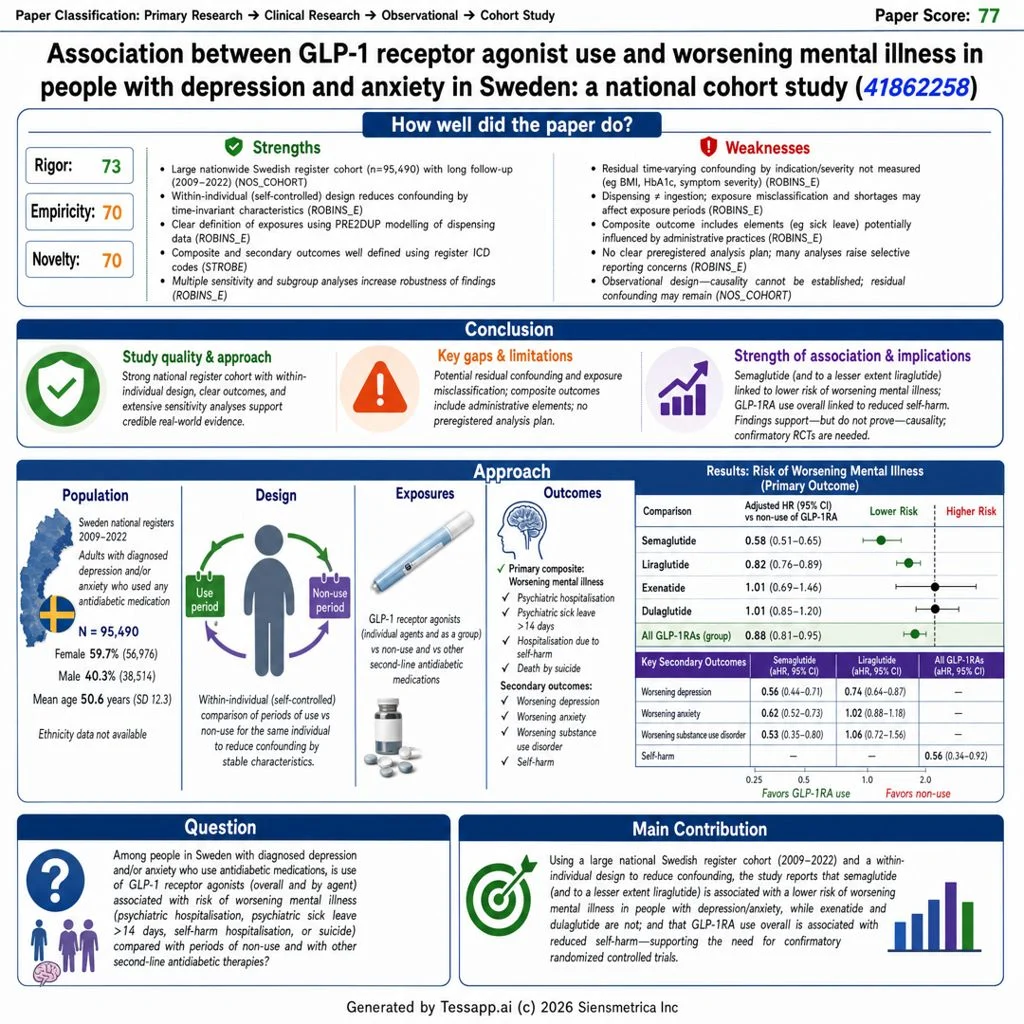
An overall score of 77 indicates that while the study isn’t a flawless clinical trial (which rarely exist), its methodology and foundation are exceptionally strong for an observational design.
- Journal and Author Prestige (Journal: 100/100, Authors: 88/100): Published in a top-tier medical journal and led by a highly credible, well-cited research team, this study passed rigorous peer-review hurdles before publication.
- Innovative Observational Design (Known to Novel: 70/100): Instead of comparing GLP-1 users to completely different individuals (which introduces massive bias), the researchers used a clever within-individual design spanning 2009–2022. By comparing patients to themselves during periods of use vs. non-use, they neutralized many hidden confounding factors.
- The Big Takeaway: The data revealed that semaglutide (and modestly, liraglutide) was associated with a lower risk of worsening mental illness and reduced self-harm in patients with pre-existing depression or anxiety.
The Caveats: What Tessa Flags for Closer Inspection
Tessa’s superpower isn’t just celebrating good science; it’s highlighting the boundaries of the data. Tessa graded the study’s scientific rigor at 73/100 and its theoretical-to-experimental transition at 70/100 due to a few key real-world limitations:
- Observational, Not Experimental: This is a registry-based cohort study, not a randomized controlled trial (RCT). While the within-person design is strong, it cannot definitively prove causality.
- Missing Clinical Granularity: The researchers relied on administrative proxies (like psychiatric hospitalizations or sick leave over 14 days) rather than direct symptom-scale measurements. Tessa also noted a lack of time-varying data like BMI or HbA1c trajectories, leaving room for residual confounding.
The Verdict
This study provides strong, real-world epidemiological evidence that certain GLP-1s like semaglutide may possess neuroprotective or mood-stabilizing properties. It effectively greenlights the immediate need for randomized clinical trials to test these psychiatric benefits directly.
Want to explore the full data visualization, inspect the author network, or review the media impact score?
👉 Access the Tessa Report Here
Share This →
About the Author: Sage Osterfeld

Research Spotlight


Recent Posts