Evaluating the Breakthrough Semaglutide Study on Alcohol Use Disorder
Category: Clinical Research Transparency / GLP-1 Trends
But in an era of rapid scientific publishing and high media noise, how do clinicians, researchers, and stakeholders know which studies are truly foundational and which require a second look?
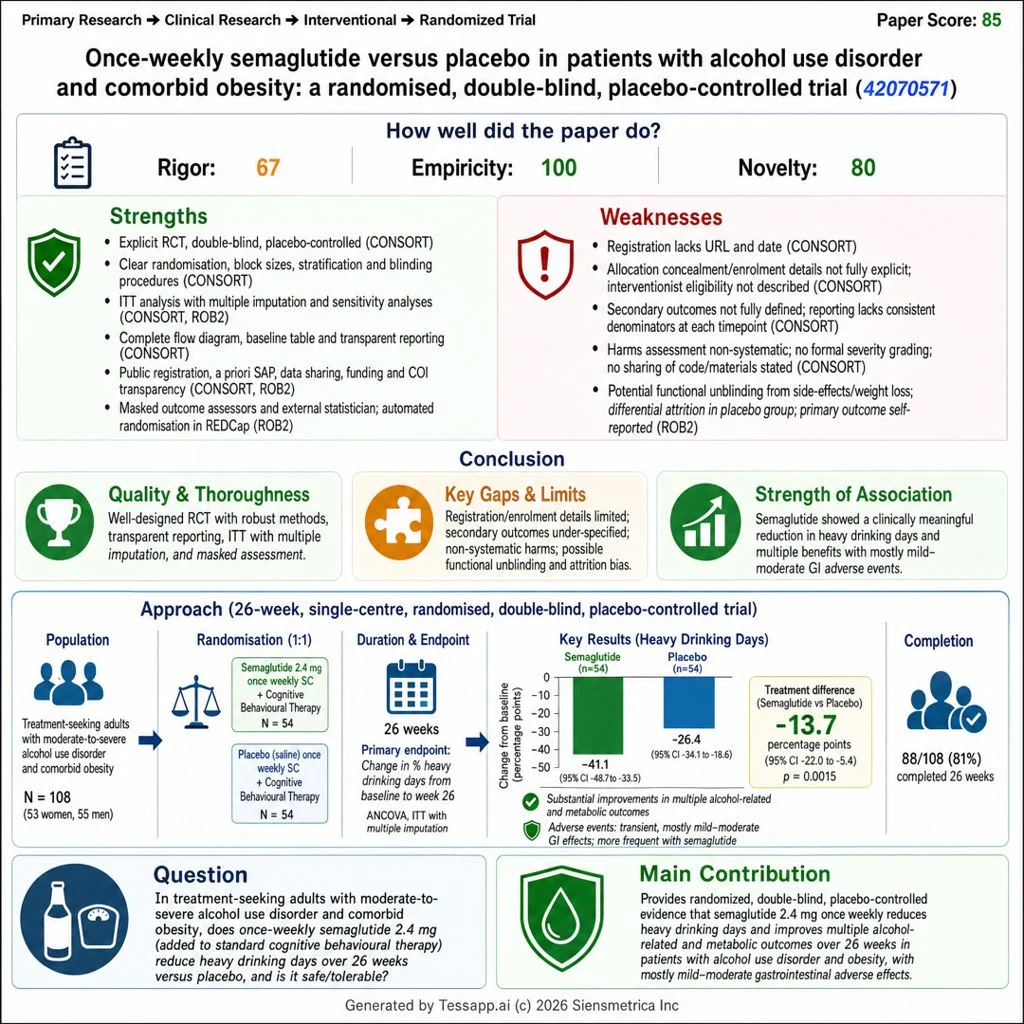
One of the most talked-about recent studies: “Once-weekly semaglutide versus placebo in patients with alcohol use disorder and comorbid obesity: a randomised, double-blind, placebo-controlled trial” published in The Lancet concluded that a once-weekly semaglutide not only reduced the number of heavy drinking days, but also improved metabolic outcomes with only nominal side effects.
We ran this paper through Tessa to see how well its promises hold up.
The Tessa Verdict: A Verified Green Light
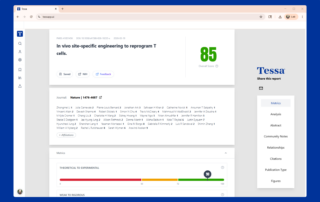
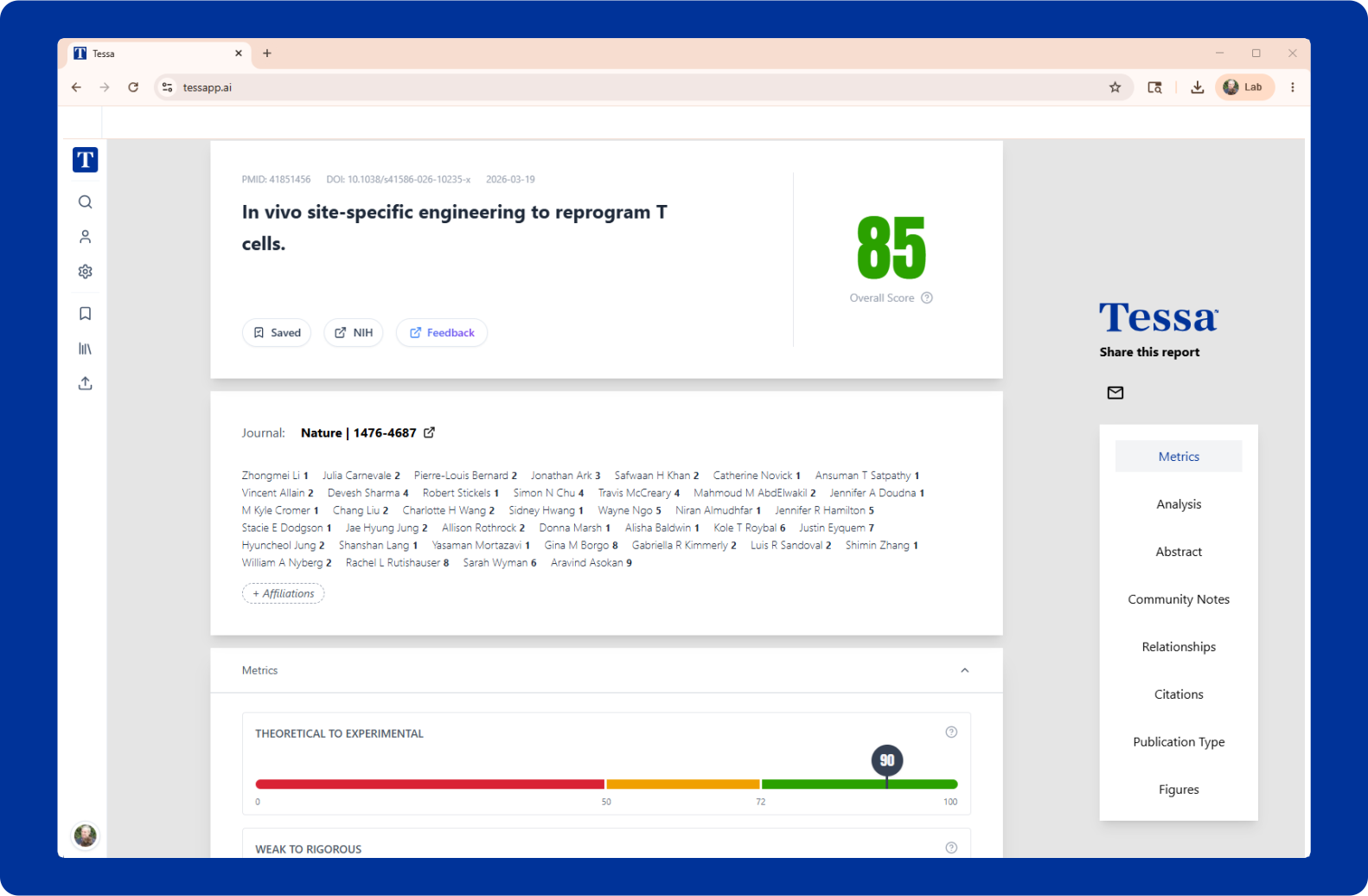
Overall T-Score: 85/100 (Green 🟢)
Tessa Insights: A TScore of 85 places this study firmly in our “Green” tier, and in the top 5% of all research Tessa has analyzed, indicating highly trustworthy and robust science. However, science is never perfect (there is no such thing as a 100 score).
Here is exactly how Tessa evaluated the paper across its key categories:
The Deep Dive Breakdown
- Theoretical to Experimental Score: 100/100: Tessa awarded a perfect score here because the trial is highly empirical and deeply intervention-based. It features a rigorous randomized, double-blind, placebo-controlled design with 108 treatment-seeking patients. Crucially, researchers didn’t just rely on self-reported data; they utilized objective biomarkers like phosphatidyl ethanol (PEth) to track actual alcohol consumption.
- Known Method to Novel Method Score: 80/100: While the basic mechanistic rationale for GLP-1s reducing alcohol intake has been observed in preclinical models, applying once-weekly semaglutide 2.4 mg in a well-powered, 26-week human clinical trial is a highly novel, translational leap forward.
- Journal Impact Score: 100/100: Published in a top-tier, highly respected medical journal, passing an incredibly stringent peer-review process.
- Weak to Rigorous Score: 67/100: This is where Tessa provides the crucial nuance that a simple headline cannot. While the primary efficacy claim (that semaglutide reduces heavy drinking days) is solidly supported, Tessa identified key structural caveats:
- Functional Unblinding: Because semaglutide causes distinct gastrointestinal side effects and rapid weight loss, some patients and clinicians likely deduced who was receiving the active drug versus the placebo.
- Statistical Limitations: The study lacked strict multiplicity controls for its numerous secondary and subgroup analyses, meaning broader generalizations about specific subgroups or rare safety outcomes remain tentative.
The Verdict
This study represents a massive step forward in expanding the therapeutic horizon for semaglutide. Tessa confirms that the core findings are highly credible and rigorous, even while smartly flagging the real-world limitations of keeping GLP-1 trials completely blinded.
Want to dive deeper into the data, view the relationship graph, read the full abstract, and see the exact author subscores?
Share This →
About the Author: Sage Osterfeld

Research Spotlight


Recent Posts