What “Forest Medicine” Tells Us About Science, Intuition, and Just Going Outside

Tessa taking a little time in the forest
We have instinctively known for eons that spending time in nature is good for us. Yet, when scientific papers try to dissect this ancient human truth, the results can sometimes get over-hyped as “powerful” or “clinical breakthroughs.”
Today, Siensemetrica is putting the spotlight on a highly discussed review by Dr. Qing Li: “Effects of forest environment (Shinrin-yoku/Forest bathing) on health promotion and disease prevention -the Establishment of ‘Forest Medicine’“.
Let’s look past the headlines and dive into what the data actually says.
What is “Forest Medicine”?
Published in Environmental Health and Preventive Medicine, Dr. Li’s narrative review outlines the establishment of “Forest Medicine”, an interdisciplinary field combining alternative, environmental, and preventive medicine. The paper synthesizes years of research on Shinrin-yoku (forest bathing), which is defined not as rigorous exercise like jogging, but as the simple act of being in nature and connecting with it through all five senses.
The review gathers previous evidence showing that forest environments may promote physical and mental well-being by lowering stress, improving sleep, and regulating our nervous systems.
The Noteworthy Science of “Going Outside”
While we don’t need a clinical trial to tell us that a walk in the woods is relaxing, Dr. Li’s review highlights some genuinely fascinating physiological mechanisms that happen when we commune with nature:
- The Volatile Power of Phytoncides: Trees release organic compounds called phytoncides (like alpha-pinene and limonene) to protect themselves. When humans breathe these in, they act like a natural aromatherapy that directly influences our biology.
- Boosting Our Natural Defenses: Dr. Li’s prior experiments show that forest bathing trips significantly increase human Natural Killer (NK) immune cell activity, the absolute number of NK cells, and the intracellular levels of anti-cancer proteins (such as perforin and granulysin).
- Long-Lasting Benefits: Remarkably, these immune-boosting effects were shown to last for up to 30 days after a forest trip.
- The City Control Experiment: To prove the forest itself was the active ingredient, researchers sent subjects on city trips with identical walking distances. The city trips did not produce these physiological benefits, indicating the effects are truly unique to natural environments.
- Hormones and Cardiovascular Health: Walking in forests was shown to reduce blood pressure, decrease stress hormones (like adrenaline, noradrenaline, and cortisol), and balance the autonomic nervous system by activating our “rest and recover” parasympathetic state.
Tessa Assessment Insights
Overall T-Score: 58 (🟡 Yellow / Moderate)
Some commentators have claimed this paper provides “powerful” evidence that “makes a strong scientific case for incorporating regular time in nature” into preventive medicine. However, Tessa evaluated this paper and issued an overall TScore of 58.
Why a yellow score? In science, structural design dictates trust. Because this paper is a Narrative Review, it presents no new primary experimental data or trial registrations. It is a descriptive synthesis of prior, mostly small-scale human field studies. While these findings are valuable, many of the underlying trials suffered from small sample sizes, a lack of experimental blinding, and limited randomization.
But here is the Siensemetrica takeaway: not all science needs to score a flawless green to be deeply meaningful. Trying to force rigid, clinical-trial metrics onto a highly intuitive human experience is rarely a perfect fit. We know that humans find peace and restoration in nature — whether it’s a forest, a beach, or a desert. This study doesn’t need to be a bulletproof medical breakthrough to validate what mothers have told their children since the dawn of time: “Go outside and play. It’s good for you.”
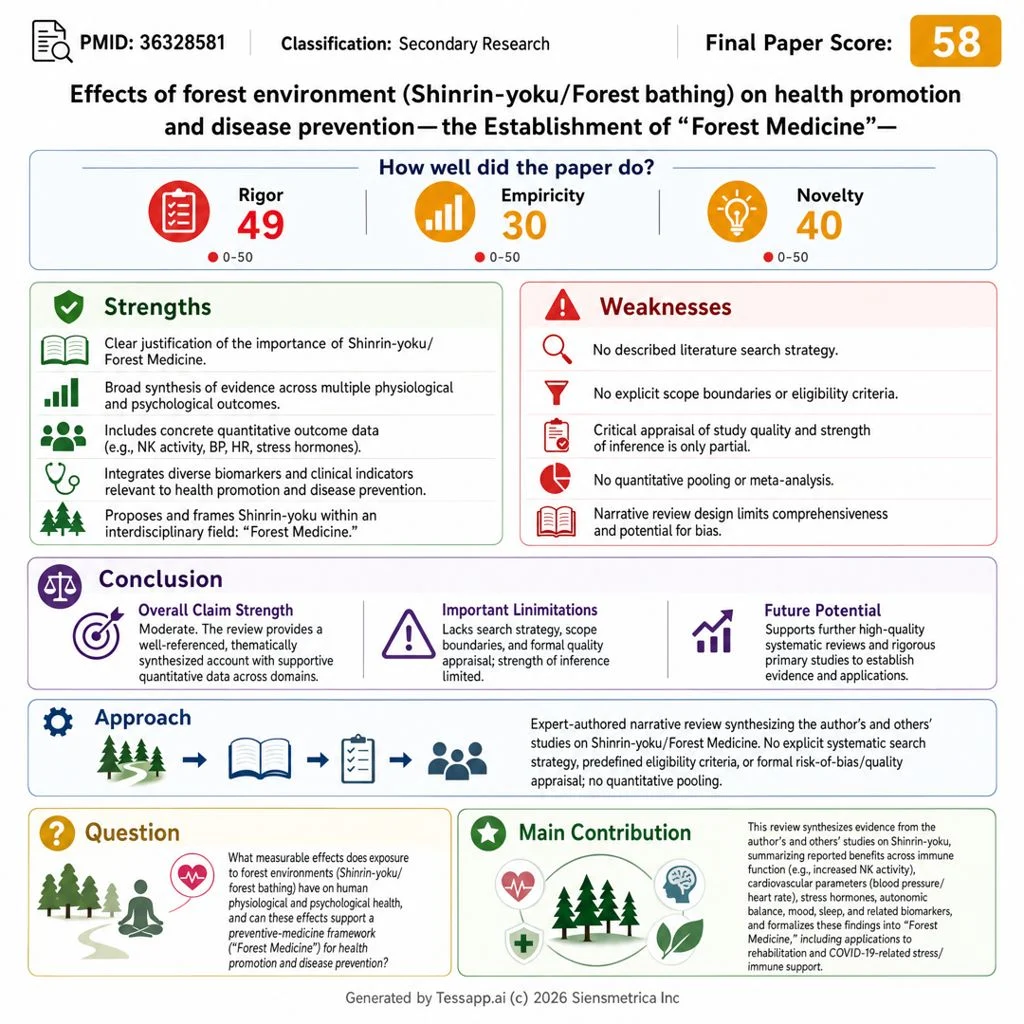
A graphical illustration of Tessa’s analysis of the paper
Tessa Summary Analysis Results
📊 Tessa Sub-Scores
| Category | Score | Tessa Insight |
|---|---|---|
| Theoretical vs. Experimental | 30 | Largely descriptive narrative review; contains no new trial data or primary statistical analyses. |
| Weak to Rigorous | 49 | Relies on small, unblinded field studies with limited randomization. Extrapolations to cancer or COVID-19 prevention are highly inferential. |
| Known to Novel | 40 | The core question is well-studied; the novelty lies primarily in the conceptual branding of “Forest Medicine”. |
| Authors Score | 100 | Outstanding author authority; Dr. Li is a preeminent researcher in this specific niche. |
| Journal Score | 51 | Respectable journal impact and reach. |
Protocol Assessments
Methodological Quality (SANRA+ Assessment)
- Overall Methodological Quality: 🟡 MODERATE (13/20)
- SANRA Core Score: 8/12 (Strong topic justification, but lacks focused review questions and explicit search methodology).
- Transparency Score: 2/4 (Key findings are highly traceable to sources, but explicit scope boundaries are undefined).
- Interpretive Quality Score: 3/4 (Excellent thematic integration and mechanistic pathways, but critical evaluation of study bias is only partial).
Tessa Citation Analysis
- Verified References: 89% (56 out of 63 references successfully verified).
- Average Citation Relevance: 7.1/10 (highly appropriate citation alignment).
- Citation Relevance Distribution:
- 🟢 Excellent (8-10): 48% (94 citations)
- 🟡 Good (5-7): 37% (72 citations)
- 🟠 Fair (3-4): 9% (18 citations)
- 🔴 Poor (1-2): 6% (11 citations)
Read the full, unedited analysis report here (includes links to the study): https://www.tessapp.ai/report/36328581
Share This →
About the Author: Sage Osterfeld

Research Spotlight

Recent Posts