Coffee, Testosterone, and What the Data Really Tell Us

Coffee, testosterone, body fat, BCAAs, and a surprisingly complicated story
Coffee and health have a complicated relationship. Depending on the study (or the headline) it can seem like coffee is either a health food or something we should be avoiding.
This study takes a more detailed look.
Researchers analyzed data from 2,264 46-year-old participants in the Northern Finland Birth Cohort 1966 to examine how habitual coffee consumption relates to body composition, metabolic markers, and sex hormones.
Rather than relying solely on self-reported health outcomes, the researchers combined several objective measurements, including proton nuclear magnetic resonance (NMR) metabolomics, liquid chromatography–tandem mass spectrometry (LC-MS/MS) testosterone measurements, oral glucose tolerance testing, and bioimpedance body composition analysis.
The result is a detailed picture of the biological differences associated with habitual coffee consumption—but not necessarily an explanation for why those differences exist.
What Makes This Study Interesting?
A few findings stand out.
Leaner body composition, despite similar BMI. Participants who reported drinking more coffee tended to have lower total and visceral body fat and higher skeletal muscle mass. Yet their BMI was essentially unchanged.
That is an interesting distinction because BMI alone doesn’t capture where body mass comes from.
A surprisingly complicated testosterone picture. Among men, higher coffee intake was associated with higher total testosterone and higher SHBG. At the same time, free testosterone and Free Androgen Index (FAI) were lower.
In other words, the relationship between coffee and testosterone isn’t as simple as “more coffee = more testosterone.”
Women did not show the same increase in total testosterone, although higher coffee intake was also associated with higher SHBG and lower FAI.
Lower circulating BCAAs. Higher habitual coffee intake was associated with lower circulating levels of the branched-chain amino acids (BCAAs) isoleucine, leucine, and valine in both men and women. These metabolites are frequently associated with insulin resistance and metabolic dysfunction.
Taken together, the findings suggest that habitual coffee consumption is associated with several measurable differences in metabolic and hormonal profiles.
But association is where the story needs to stop… for now.
The Tessa Overall Score
TScore: 66 / 100 (🟡 Yellow) — Moderate Trustworthiness / Hypothesis-Generating
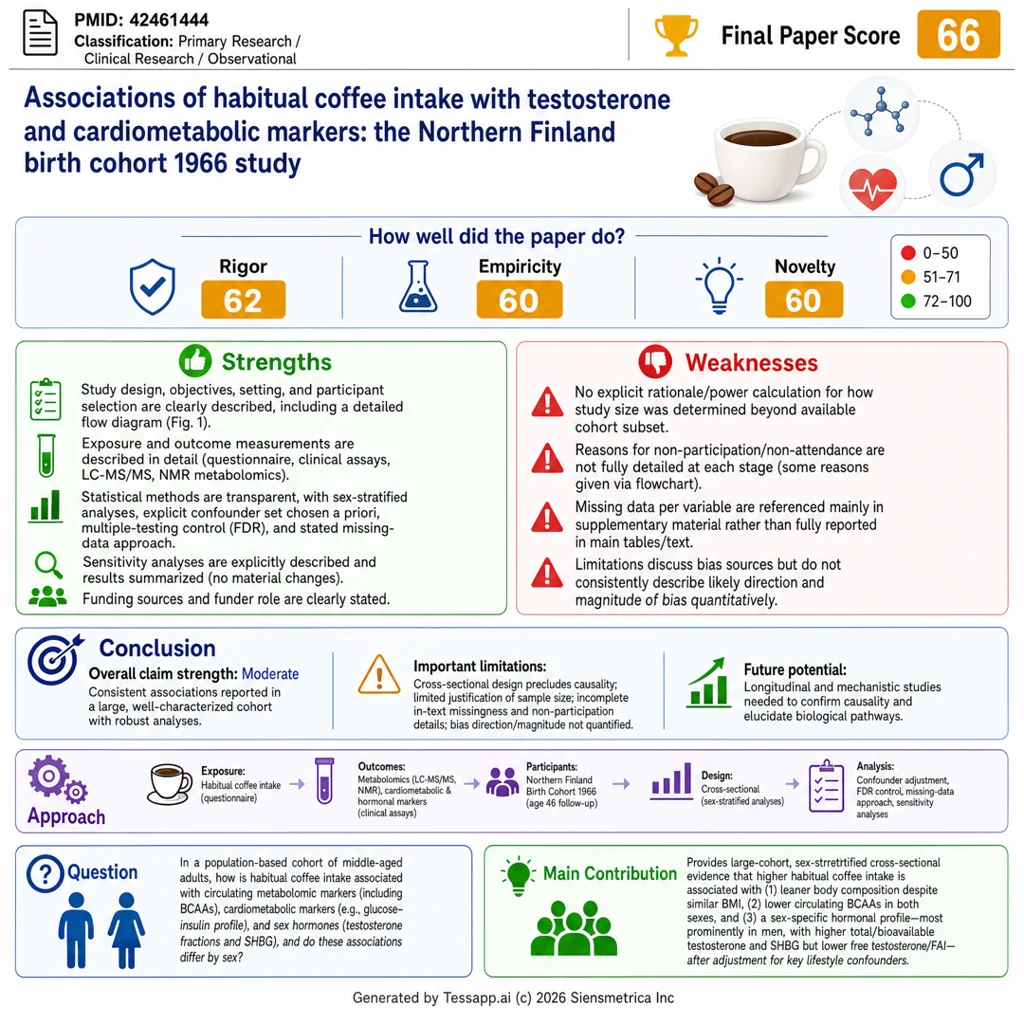
Tessa’s analysis places the study in an important middle ground: the underlying measurements are strong, the reporting is thorough, and the findings are biologically interesting. But the study design doesn’t allow us to conclude that coffee caused any of these changes.
Theoretical vs. Experimental: 60 The study is a cross-sectional observational analysis based on primary physical and biological measurements. It does not include an intervention or causal validation.
Weak to Rigorous: 62 The study benefits from objective measurements using techniques such as LC-MS/MS and NMR spectroscopy, along with multiple-testing corrections for the metabolomics analysis. However, coffee intake was self-reported, cup volumes weren’t defined, and potentially important confounding factors remain.
Known to Novel: 60 Coffee, metabolism, and hormones have been studied extensively. The novelty here comes from bringing detailed androgen measurements, BCAA metabolomics, and body composition together in a single sex-stratified cohort.
Tessa Quality & Rigor Analysis
Tessa’s deeper analysis reveals a useful distinction between how well a study is reported and how confidently its conclusions can be interpreted.
Citation Integrity: 96% Tessa verified 96% of the study’s references, with an average citation relevance score of 7.3/10 and no unverified or uncited references detected.
Reporting Completeness: 100% The study fully met the STROBE reporting framework for observational research, including participant flow, variable definitions, and statistical reporting.
Risk of Bias: High
Tessa identified several important limitations:
- Confounding: The analysis does not fully account for factors such as overall dietary patterns, sleep, stress, or female menstrual and contraceptive variables.
- Participant selection: Restricting the analysis to participants who consumed only coffee or neither coffee nor tea, along with complete-case analysis, reduced the final sample from the broader cohort to 2,264 participants.
- Exposure measurement: Participants reported cups per day, but the study did not establish precise cup volumes, roast types, or additions such as milk and sugar.
- Outcome measurement: This is where the study is strongest. Standardized clinical protocols and objective laboratory assays reduce the risk of measurement bias.
What Tessa Adds to the Conversation
This is exactly the kind of study where a headline can be more certain than the evidence.
The data show that habitual coffee consumption tracks with differences in body composition, metabolic markers, and hormone profiles.
They do not show that drinking coffee produces those differences.
People who drink more coffee may differ from people who drink less coffee in other ways that weren’t completely captured by the analysis. And because the study looks at participants at a single point in time, it cannot establish which factor came first.
That’s why Tessa classifies the findings as hypothesis-generating rather than causal.
The interesting question isn’t simply whether coffee is “good” or “bad.”
It’s what these biological associations might tell researchers about the relationship between coffee consumption, metabolism, body composition, and hormones—and what future studies would need to do to determine whether those relationships are actually causal.
See the Summary Tessa Report here: https://www.tessapp.ai/report/42461444
~|~
Share This →
About the Author: Sage Osterfeld

Research Spotlight




Recent Posts