Can a Younger Body Make an Older Heart Younger?
Every year, hundreds of people in the United States die waiting for a heart transplant. Demand keeps climbing, driven largely by an aging population: the number of U.S. heart recipients aged 65 and older rose 127% between 2010 and 2021. The supply of donor hearts has not kept pace.
Part of the problem is that a matching donor is hard to find. Another part is age. There is no official upper age limit for heart donors, but in practice donors under 45 are recommended, and few transplant programs accept hearts from donors older than 50. As the population ages, a growing share of potential donor hearts falls outside that window.
A new study from researchers at Brigham and Women’s Hospital and Harvard Medical School, with collaborators at Altos Labs and Charité in Berlin, asks a question that could change how we think about that limit: does a transplanted heart keep the biological age of its donor, or does it gradually take on the biological age of the person who receives it?
To find out, the team transplanted hearts between young, middle-aged and old mice, then measured each heart’s “biological age” four to six months later using epigenetic clocks, which estimate age from chemical tags on DNA (DNA methylation), along with gene activity profiling. They then looked for the same pattern in humans, using archived heart biopsies from 11 transplant patients and one-year functional data from hundreds of heart recipients at their hospital.
Their answer: the heart appears to adopt the biological age of its new body.
One important note before going further: this study is a preprint. It was posted publicly on bioRxiv but has not yet been through formal peer review and journal publication, a process that commonly takes months and sometimes years.
That is exactly why we chose it for this spotlight. More on that in the Tessa section below.
What Makes This Study Noteworthy
- Old hearts in young bodies looked younger. In mice, older hearts transplanted into younger recipients measured biologically younger than their donors’ age on every epigenetic clock the researchers used. The reverse was also true: young hearts placed in older recipients aged faster than they otherwise would have.
- It wasn’t just one measurement. Beyond the age clocks, the researchers looked at more than 260,000 individual DNA sites across the genome. In old hearts placed in young recipients, the pattern of change ran in the opposite direction of normal aging. In other words, the aging signature didn’t just stall; it appeared to reverse.
- The effect was a one-way street. The recipient’s own heart, liver and blood were largely unaffected by the transplanted heart. The body changed the graft, but the graft did not noticeably change the body. That matters for any future allocation strategy, because it suggests a younger recipient would not be “aged” by receiving an older heart.
- The cell’s power plants may be involved. Genes tied to mitochondria, the structures that produce a cell’s energy, showed some of the largest shifts: turned down in young hearts placed in old recipients, and turned up in old hearts placed in young recipients. The authors present this as a starting point for future research, not a proven mechanism.
- The same pattern appeared in people. In the 11 human transplant patients studied, the biological age of the transplanted heart tracked the age of the recipient rather than the donor, including in cases where the donor was up to 24 years older than the recipient.
- Recipient age, not donor age, tracked with heart function. In a separate analysis of hundreds of patients one year after transplant, the recipient’s age was linked to measures of exercise capacity (functional capacity and peak oxygen uptake, or VO2 max), even after accounting for the donor’s age.
Limitations & Cautions
This is promising early work, not a change to clinical practice. Several cautions are worth keeping in mind:
- “Biologically younger” is not the same as “performs better.” The study measured molecular age markers. It did not show that older donor hearts placed in younger recipients lead to equal or better long-term survival. Other research has linked older donor hearts to higher mortality after transplant, and the authors say this question still needs to be tested directly.
- The mouse model is a simplified version of human transplant. The mice were genetically identical, so there was no organ rejection, and the transplanted heart was added alongside the animal’s own heart rather than replacing it.
- The human molecular evidence is small. The biopsy analysis included just 11 patients, using older preserved tissue samples that are not ideal for this kind of DNA testing.
- The functional data shows an association, not cause and effect. Recipient age was linked to some (not all) measures of heart function at one year. Longer-term outcomes, such as chronic vessel disease in the transplanted heart, were not studied.
- Peer review is still ahead. As a preprint, the methods and conclusions have not yet been vetted through formal review.
Tessa Overall Score
TScore: 89 / 100 🟢 Green
Tessa scored this paper in the green range, reflecting strong experimental evidence and a genuinely novel question backed by both animal and human data.
Two of the sub-scores need context. Because this is a preprint, Tessa doesn’t penalize it for lacking a journal. And the Media Score of 40 reflects that preprints typically get less online attention than published papers.
This is where Tessa earns its keep. Formal peer review is essential, but it is slow. While a paper like this works its way through the process, the people it might eventually help are still waiting. Tessa can’t and shouldn’t replace human peer review, but it can do something the traditional process can’t: apply established, standardized review frameworks to a preprint in minutes, checking every citation, examining the study design, and showing exactly where the work is strong and where it falls short. That gives researchers, reviewers and clinicians a credible early read on high-quality work long before a journal decision arrives.
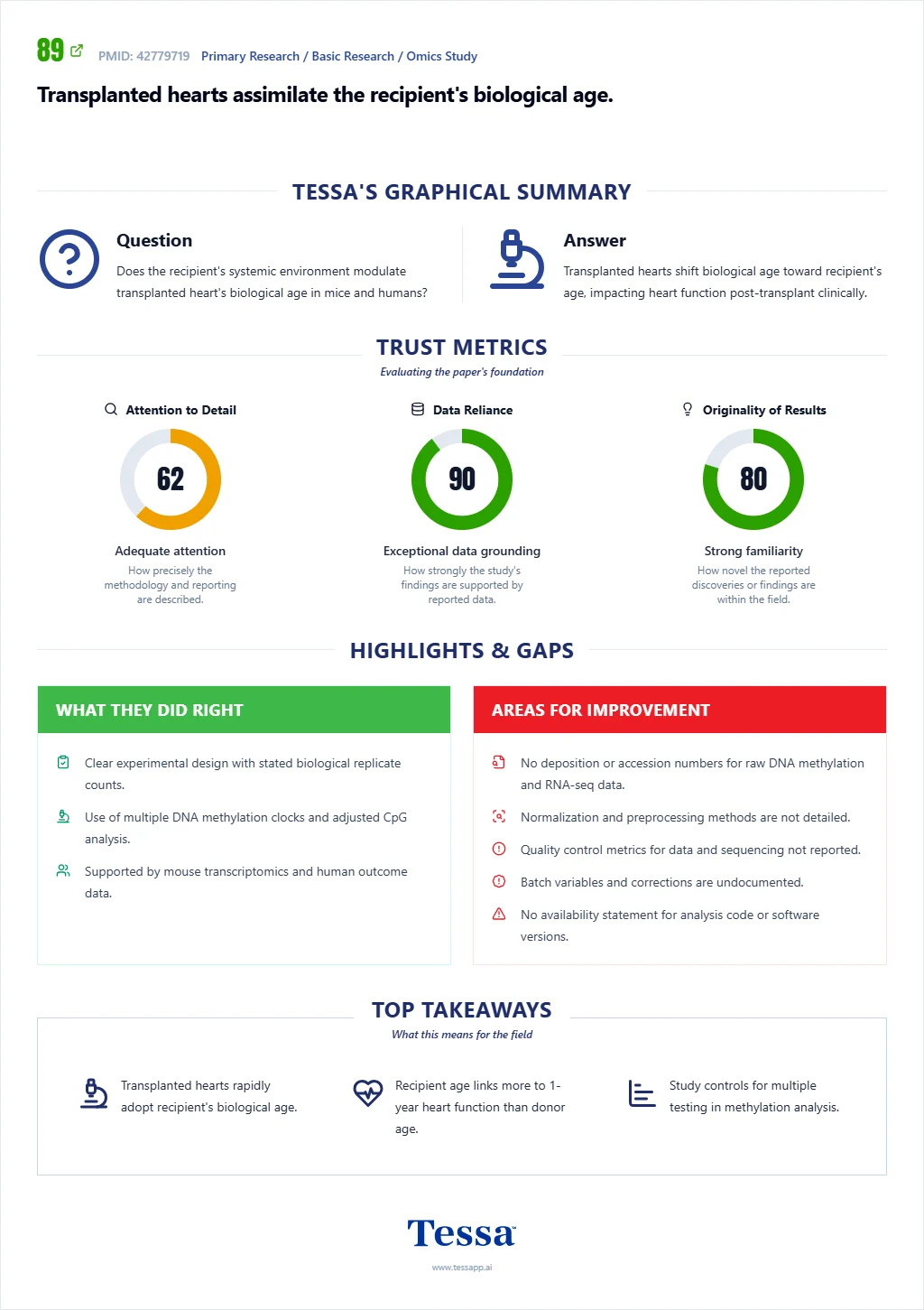
A graphical analysis of the Tessa summary report on the paper “Transplanted hearts assimilate the recipient’s biological age.”
Tessa Analysis Breakdown
Sub-Scores
| Category | Score | What it means |
|---|---|---|
| Theoretical vs. Experimental | 90 | Driven by real experimental and clinical data: controlled mouse transplants, new DNA and gene-activity data, and human patient samples and outcomes. |
| Weak to Rigorous | 62 | A coherent, well-supported story in mice. Human evidence points the same way but is small and observational. |
| Known to Novel | 80 | The idea that a young body can rejuvenate old tissue isn’t new, but directly showing a transplanted organ resetting its biological age, in both mice and humans, is. |
| Journal Score | N/A | Because this is a preprint, Tessa doesn’t penalize it for lacking a journal. |
| Media Score | 40 | Modest online attention, typical of a preprint. |
Citation Analysis
- 92% of references verified (23 of 25) as real, existing publications.
- 100% of verified references are actually cited in the text. No padding with references that are never used.
- Average citation relevance: 7.1 / 10. 62% of citations rated excellent and 38% rated good. None rated fair or poor.
Deep Dive Evaluation
Tessa classified the paper as Primary Research / Basic Research / Omics Study (86% classification confidence) and evaluated it against four established frameworks:
| Framework | What it checks | Result |
|---|---|---|
| Omics Rigor (Tessa custom framework) | Rigor and reproducibility of large-scale DNA and gene data | 🔴 Very Low (4.3 / 10) |
| FAIR Data Principles | Whether underlying data are findable, accessible and reusable | 🔴 3.8 / 10 |
| ARRIVE 2.0 | Completeness of reporting for animal research | 🟠 62% complete |
| SYRCLE | Risk of bias in animal studies | 🟡 Unclear |
How can a paper score 89 overall but “Very Low” on rigor?
This is one of the most useful distinctions Tessa makes. The overall TScore reflects the strength of the evidence: well-designed experiments, multiple lines of supporting data, and a novel, clinically relevant question. The Deep Dive frameworks measure something different: whether the paper reports enough detail for someone else to check and repeat the work. A study can produce compelling findings while still leaving out the information other scientists need to reproduce them. That gap is common in preprints, and it is exactly the kind of thing peer review typically asks authors to fix.
Strengths
- Clear, controlled comparisons in mice: old-to-young, young-to-old and same-age transplants, plus sham surgery controls.
- Multiple independent epigenetic clocks agreed, and the gene-activity data pointed in the same direction.
- Results were extended from mice to humans, at both the molecular level and in one-year heart function data from hundreds of patients.
- Strong citation integrity, with every verified reference used and relevant.
- The authors openly discuss the study’s limitations and the differences between their mouse model and human transplantation.
Weaknesses
- No public data repository or accession numbers for the DNA and gene-activity data, so others can’t yet access the raw data.
- No statement on availability of the analysis code.
- Key processing details (data normalization, quality-control measures, batch handling) are not described in the text Tessa evaluated.
- No reporting on randomization, blinding, or animal housing and welfare monitoring.
- No ethics approval statements or pre-registered analysis plan in the evaluated text.
- Small group sizes (typically 4 to 6 mice per group) and a small human biopsy cohort (11 patients), with no formal sample-size justification.
Read the Full Tessa Analysis
Tessa’s full report goes further than we can here. In addition to everything above, it includes an Author Report for each researcher (with a Google Scholar search), a relationship chart mapping the researchers, their institutions and the funding organizations disclosed in the paper, a citation timeline, and a table of every figure and illustration in the study that can be clicked for a reverse image search.
Read the full Tessa analysis: https://www.tessapp.ai/report/db65e1ed-91ce-e427-880b-8e62ba0f43e9
Share This →
About the Author: Sage Osterfeld

Research Spotlight



Recent Posts